

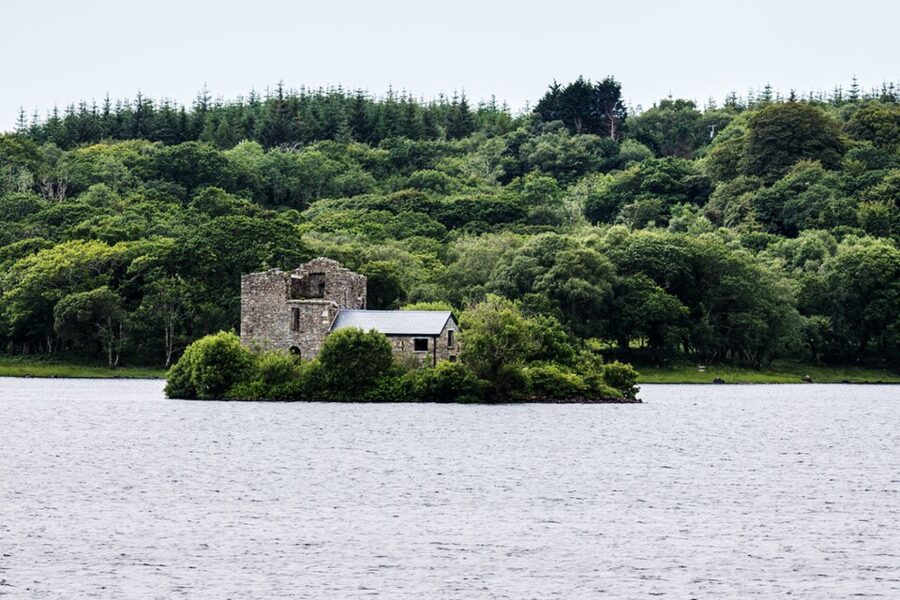
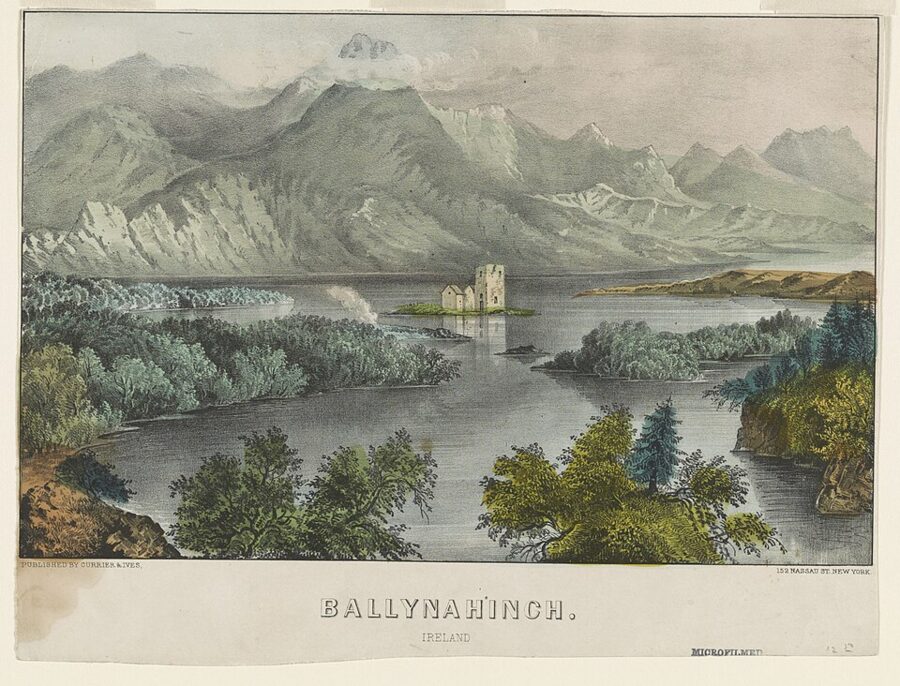
A square stone tower stands on an island hardly bigger than a garden in Ballynahinch Lake, roofless, with ivy and a few trees for company. It sits about a kilometre north of the grey castle hotel on the river, screened by woods, and you could drive the N59 along the lake for years without seeing it. It is the oldest thing here, and it gave the whole place its name.
Ballynahinch (Baile na hInse) means the settlement, or homestead, of the island. The island is that one, and the settlement was whatever the O’Flahertys kept around their tower. Everything else at Ballynahinch came later: the Martins and their 200,000 acres, a famine that broke them, an insurance company, a London brewer, an Indian prince who played cricket for England, and since 1946 a hotel.
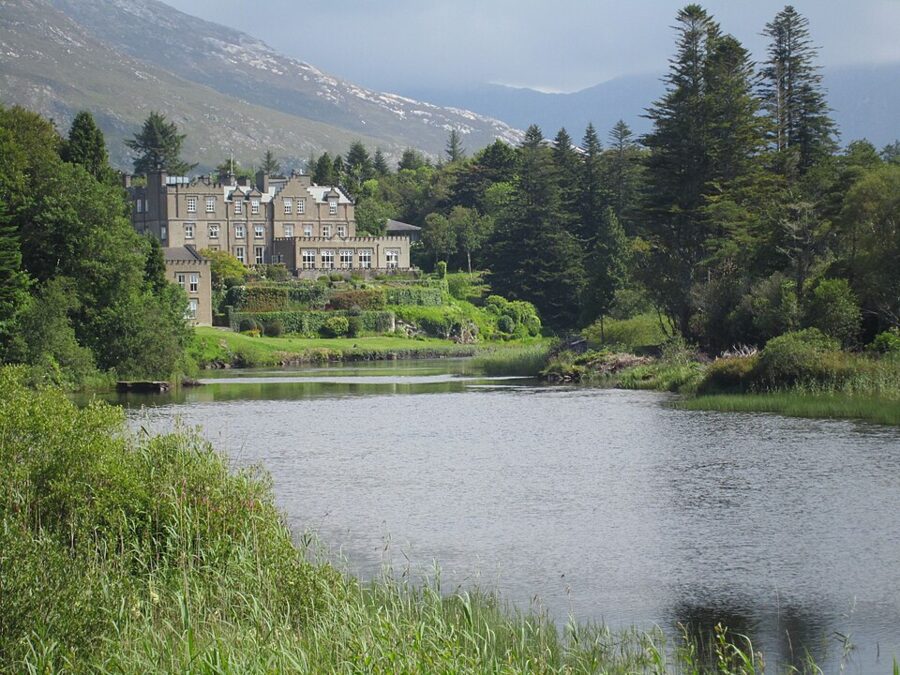
Around the house lie the river and woods of the estate, and beyond them Sraith Salach (Recess), the marble hill of Lissoughter, Derryclare and the Inagh Valley. Ballynahinch is in the middle of Connemara, a quarter of an hour from Clifden and about an hour from Galway, and it rewards half a day more than a drive-by.

On this page9 sections
The name, the lake and the island castle
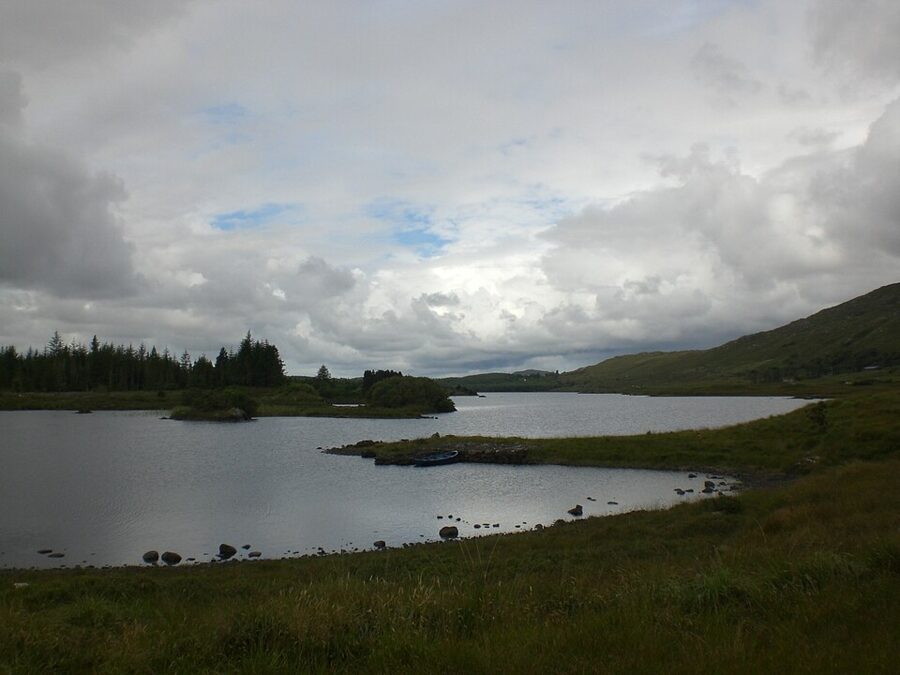
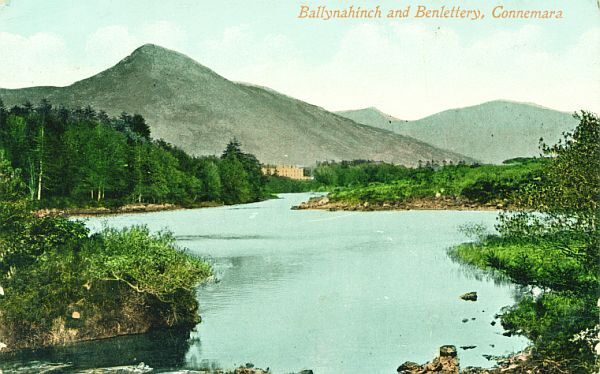
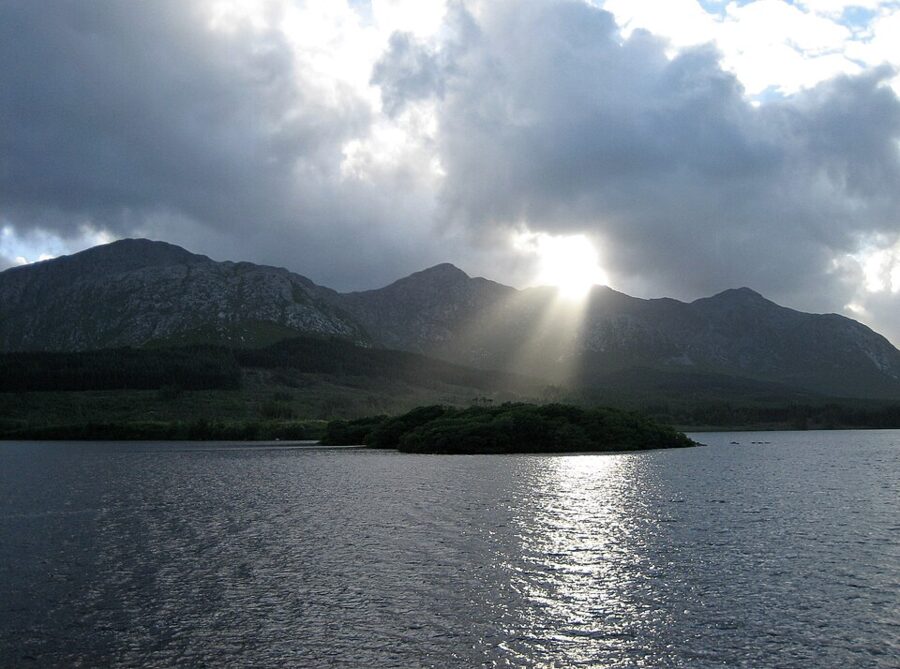
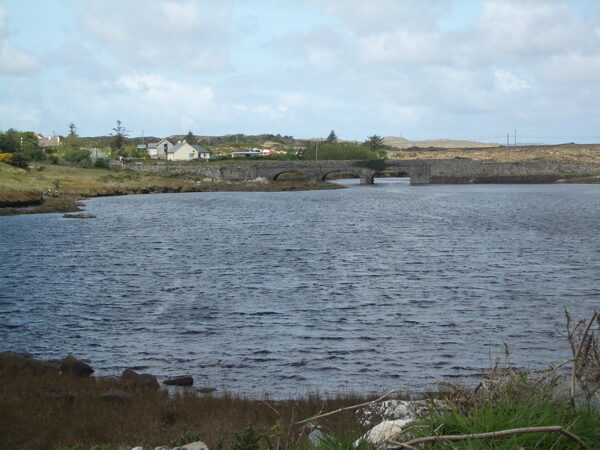
Ballynahinch Lake (Loch Bhaile na hInse) is about 4 km long and a kilometre wide, lying east to west under the southern end of the Twelve Bens. Benlettery (Binn Leitrí, the peak of the wet hillsides) rises straight above its western end. Water comes in at the east from Derryclare Lough, which takes it in turn from Lough Inagh and the streams of the Bens and the Maumturks, and leaves by the short Ballynahinch River, also called the Owenmore (An Abhainn Mhór, the big river).
That river runs about 3 km south from the castle to the sea at Toombeola, where it meets Bertraghboy Bay (Cuan na Beirtrí Buí). The fishery puts the whole catchment at 68 square miles, about 176 km² of lakes, rivers and bog. Every salmon and sea trout bound for any of it has to come up those 3 km first, which is the single fact that explains most of what happened here.

The O’Flaherty tower
The tower on the island is a tower house of the O’Flahertys (Ó Flaithbheartaigh), lords of Iar Connacht, the country west of Lough Corrib that is roughly Connemara today. Their other castles stood at Aughnanure, Bunowen, Doon, Moycullen and Renvyle. Who built the Ballynahinch tower, and when, depends on who you read.
The usual account credits Dónal an Chogaidh Ó Flaithbheartaigh, Dónal of the battles, around 1546, the year he married Gráinne Ní Mháille, Grace O’Malley. Another tradition, kept in the story of the Dominican abbey at Toombeola, says Tadhg na Buile O’Flaherty built a castle on the island with stones carried up from the abbey after soldiers drove the friars out in 1558–59. Both can be partly true. Neither is backed by a building record.
Treat Grace O’Malley’s part as lore with some history underneath. She did marry Dónal an Chogaidh in 1546, and their sons Owen and Murrough were O’Flahertys of this country. Dónal was killed in an ambush in the hills around Lough Corrib in 1565, in a feud with the Joyces over Hen’s Castle, and Grace went home to Clew Bay. The picture of her dividing her time between Ballynahinch and Bunowen comes from local telling, not from documents.
The firmer dates come in the 1580s. Murrough na dTuadh O’Flaherty, the Crown’s choice as chief of the name, took Ballynahinch in 1584, by the hotel’s history of the house, and Grace’s sons won it back the same year. In 1586 Captain John Bingham came this way with 500 men, hanged eighteen of Owen O’Flaherty’s followers and had Owen himself killed in custody, with his cattle and horses driven off. Murrough kept the castle into the early 1600s.
The Martins of Ballynahinch
The Martins were one of the fourteen Tribes of Galway, merchant families of Anglo-Norman descent, and are said to have been the first of them to settle outside the city walls. A junior branch of the Martins of Ross was granted the O’Flaherty lands in Connemara in the mid 17th century, under the Acts of Settlement. A patent of 1698 confirmed them in the Manor of Claremount, and in 1699 Richard Martin bought over 27,000 more acres in the baronies of Moycullen and Ballynahinch.
For a long time they lived nearer Galway, at Birch Hall and Dangan on the Corrib. The Landed Estates Database at the University of Galway describes the house at Ballynahinch as built in the centre of their estate. The family’s tradition is that Richard Martin’s father built it as an inn, an idea that lands with some irony on a building that has been a hotel for eighty years.
On the date, the sources do not agree. The National Inventory of Architectural Heritage gives 1754, the year Richard was born; the hotel’s own estate map says 1756. The inventory rates it of national importance, notes the terraced gardens below the south front, and says Maria Edgeworth’s description of 1833 shows a house that has changed its appearance many times.
Humanity Dick
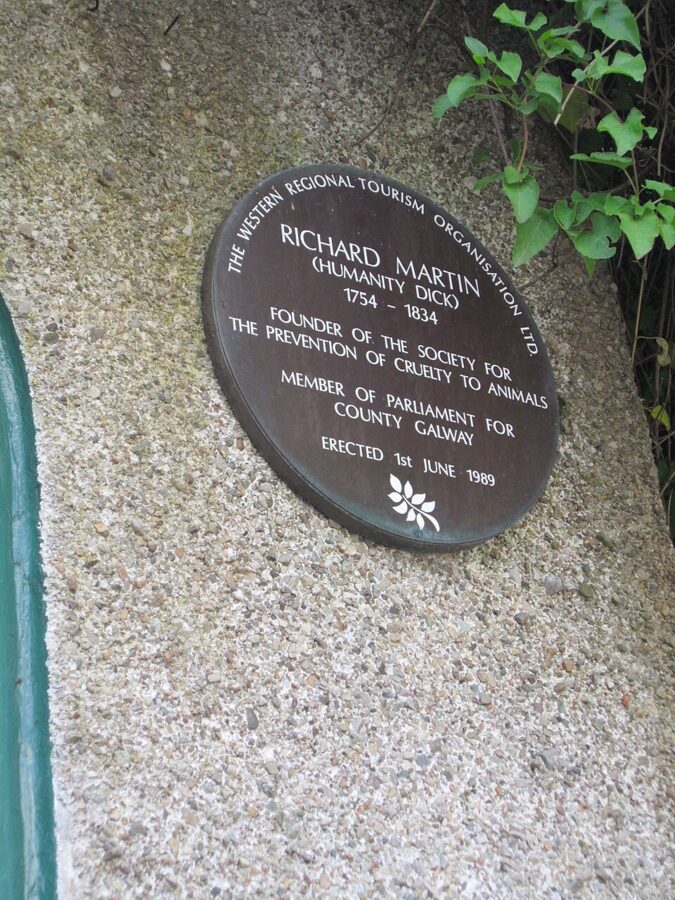
Richard Martin was born at Dangan in January 1754, schooled at Harrow and Cambridge, and called to the bar. He was the first of his family raised a Protestant, which let him sit in parliament: in the Irish Commons from 1776, then, with gaps, for County Galway at Westminster after the Act of Union, until 1826.
He moved to Ballynahinch for good around 1813, after work on the house, and lived like a lord of the west. He fought so many duels that he was called Hair-trigger Dick. The story that he owned the longest avenue in Europe, forty-odd miles of his own land from near Galway to the front door, is the sort of thing told about him; the acreage, at least, was real.
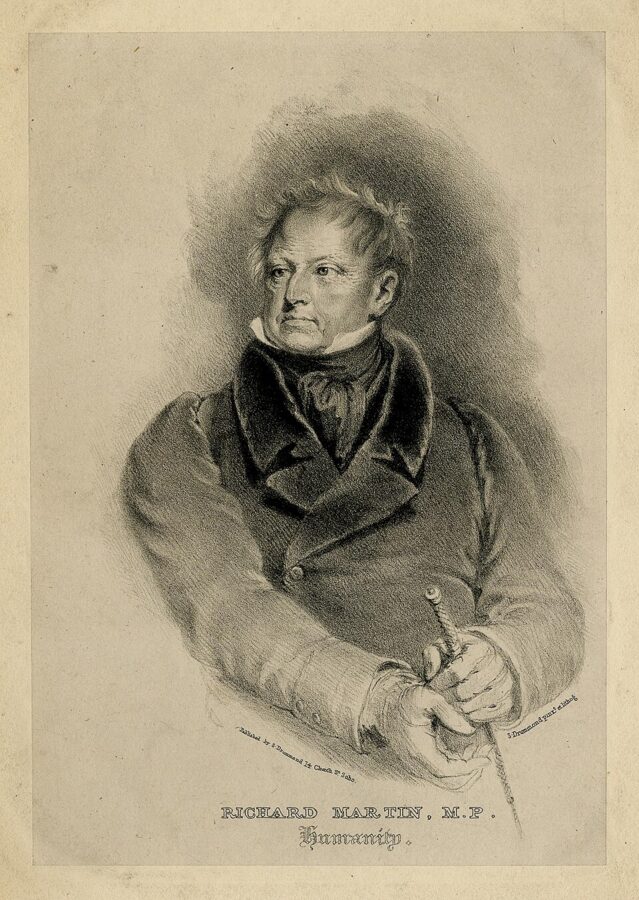
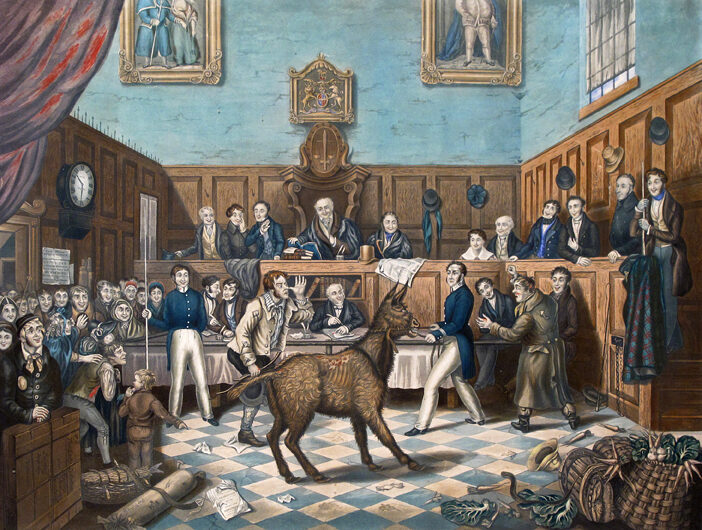
Humanity Dick was the name that stuck, and it came from one piece of law. Martin’s bill “to prevent the cruel and improper Treatment of Cattle” passed the Commons by 29 votes to 18 and became law on 21 June 1822. It covered cattle, sheep and working animals, and it is usually counted as the first animal welfare act in the world.
He then went out and enforced it himself, bringing cases against drovers and carters in London and sometimes paying the fines of the poor men he had prosecuted. He was at the meeting in a London coffee house in June 1824 that founded the Society for the Prevention of Cruelty to Animals, later the RSPCA. The founder in the society’s own sense was the Reverend Arthur Broome, and Martin said so publicly at the first anniversary meeting.
The end was money. After the 1826 election Martin was unseated on a petition alleging intimidation of voters, and without a seat he lost the parliamentary immunity that had kept his creditors off. He went to Boulogne and died there on 6 January 1834. The deathbed line the family likes, that he spared animals and not men because no ox ever carried a pistol, is a story with no witness to it.

Thomas Martin and the Famine
Richard’s son Thomas Barnwall Martin (1784–1847) fought at Badajoz in 1812, came home wounded, inherited an estate already deep in debt and won his father’s old seat for County Galway in 1832. He held it until he died. The Martin lands then ran to nearly 200,000 acres, in the baronies of Ballynahinch, Moycullen, Ross and Galway, among the largest estates in Ireland and almost all of it poor, wet, rented ground.
The potato failed in 1845, and the west of Connemara had one of the highest death tolls in the country. Thomas Martin went to see his tenants in the workhouse at Clifden. He caught famine fever there and died of it in April 1847, by the family’s account asking what would become of his people.

Mary Martin, the Princess of Connemara
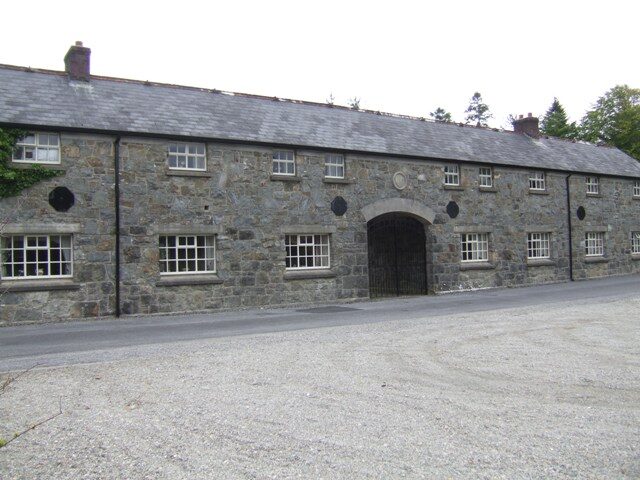
His only child, Mary Letitia Martin, was born in 1815 and grew up at Ballynahinch speaking Irish as well as English and French. Maria Edgeworth met her on her tour of Connemara in 1833 and wrote about her, and she was known as the Princess of Connemara. She published a novel, St. Etienne, in 1845, and in 1847 married a cousin, Arthur Gonne Bell, who took the name Martin.
That same year she inherited the whole encumbered estate. The rents had collapsed with the Famine, and what was left of her own money went in the next two years on trying to keep her tenants alive. Penniless, she and her husband left for Belgium, where she wrote for magazines, and in 1850 they sailed for New York. She gave birth prematurely on the ship, and the baby died; she died in the city about ten days after landing.
The insurance company’s estate
The Martin lands nearer Galway, Dangan and Bushypark among them, were put up for sale in 1849. The Connemara estate was mortgaged to the Law Life Assurance Society of London, and in 1852 the Encumbered Estates Court sale passed it to them. A land surveyor, Thomas Colville Scott, went over all of it in 1853 for a buyer who never bought; his journal was published in 1995 as Connemara after the Famine, edited by Tim Robinson, and it is the best close-up of the place in those years.
The Law Life Assurance Society’s entry in the same database records it holding over 165,000 acres in County Galway in the 1870s. It let the houses: Glendollagh House at Recess went to a John Strutzer, and the Robinsons of Roundstone acted as agents. For twenty years the biggest landlord in Connemara was a life assurance company in London.
Berridge, Ranji and the fishery
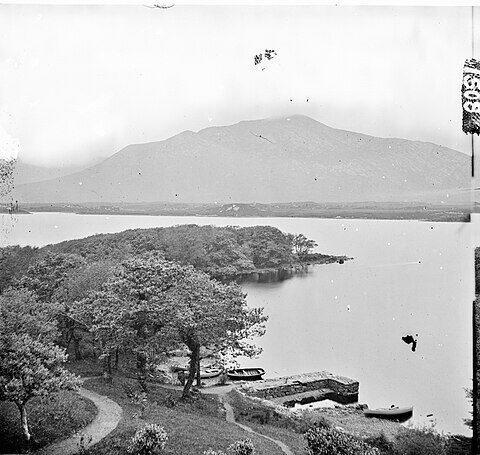
In 1872 the Society sold Ballynahinch to Richard Berridge, a London brewer with land in Middlesex and Kent who bought much of west Connemara for sport. A court case over the sale, Jervis against Berridge, ran into 1873. The Berridges enlarged the castle to roughly its present shape, adding the top storey about 1890, built fishing lodges such as Inagh Lodge on Lough Inagh in the 1880s, and ran the river as a private fishery.
In the 1920s the fishing drew the most famous owner the place has had. Kumar Shri Ranjitsinhji, Ranji, had been one of the great batsmen of the 1890s, playing for Sussex and in fifteen Tests for England, and from 1907 he was Jam Sahib of Nawanagar, a princely state on the west coast of India. He had lost an eye in a hunting accident, which ended his cricket, and spent his summers in Britain and Ireland.
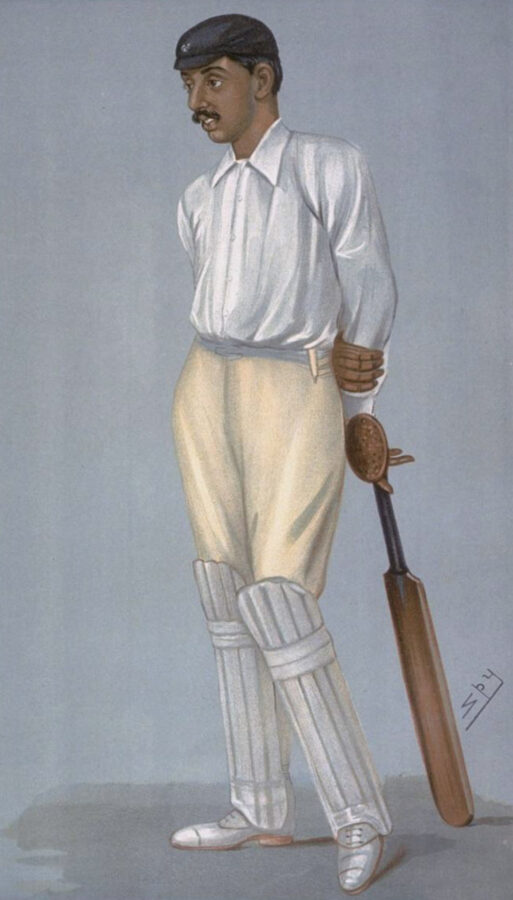
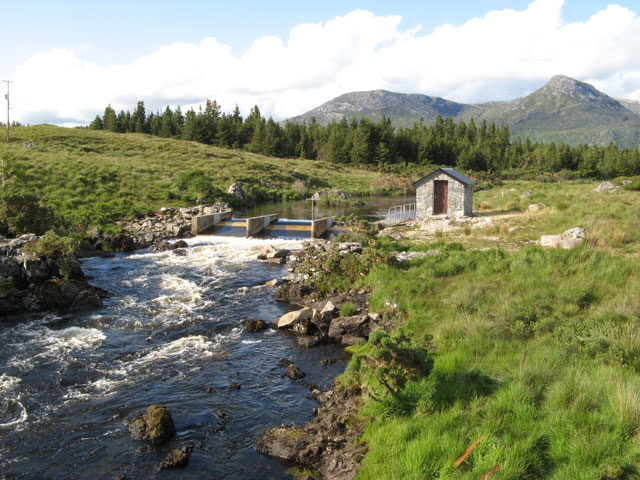
He rented first and then bought the house, estate and fishery from the Berridges: in 1924 by most accounts and the hotel’s own, in 1926 by the Landed Estates record for Ballynahinch Castle. He spent on it like a prince. He landscaped the woods and gardens, put footbridges and weirs on the river and built the stone casting piers, over seventy of them, that let an angler reach the lies on the awkward throws.
The stories told about him at Ballynahinch are many and mostly unprovable: the avenue covered in white marble chips and raked every morning, five new motor cars bought in Galway each June and given away in October, a staff party every birthday in the billiard room, which is now the bar, and two nieces sent to school at Kylemore. Two things are firmer: he came by train in his own carriage to Ballynahinch station, and he employed more than fifty local people on the estate.
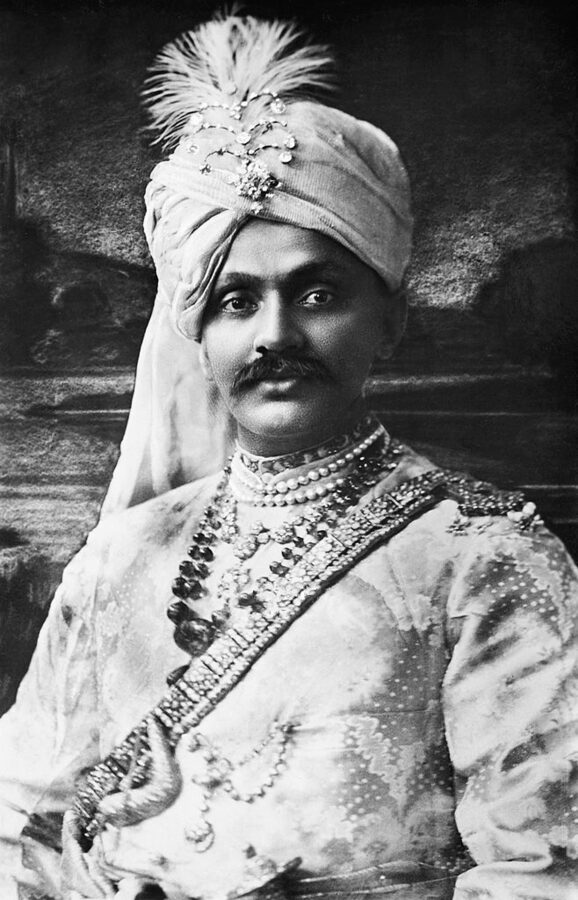
He died at Jamnagar on 2 April 1933. The Ballynahinch version moves it to 1 April, so that nobody at home believed the news, and the hotel’s own history gives the year as 1932; the other records agree on 2 April 1933. His nephew Duleepsinhji, another England batsman, inherited and sold to the McCormack family of Dublin.

A hotel since 1946
In 1946 the Irish Tourist Board, the forerunner of Bord Fáilte, took the castle over and opened it as a hotel, and for the first time the fishery was let to anyone who paid. That saved the house.
In the early 1950s Noel Huggard took on the running of it together with Ashford Castle. He sold off much of the land, including the fishing on Inagh and Derryclare, and in 1957 sold the castle and fishery to an American businessman, Edward Ball. Ball’s associate Raymond Mason ran it from 1978 and renovated it; the present owners bought it from the Masons in 2013.

The estate today
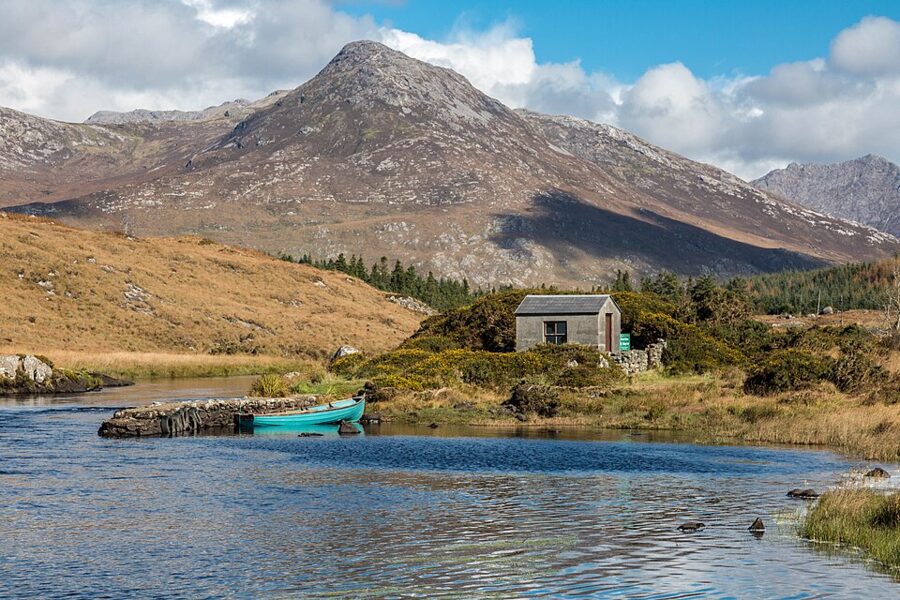
Ballynahinch Castle is now a 48-room hotel and a member of Relais & Châteaux. Its walled garden, river and woods take up most of a private estate the hotel now gives as 1,500 acres; other descriptions, some recent, say 450 or 700. Rooms were advertised from about €325 a night with breakfast in late 2026.
Non-residents come for the bar and the food. The Fisherman’s Pub and Ranji Room serve food and pints by an open fire, with Cleeve Miller’s portrait of Grace O’Malley on the wall, and the Owenmore Restaurant does the formal dinner looking at the river. A drink in the pub is the easy way to see the house without booking a room.

The walks
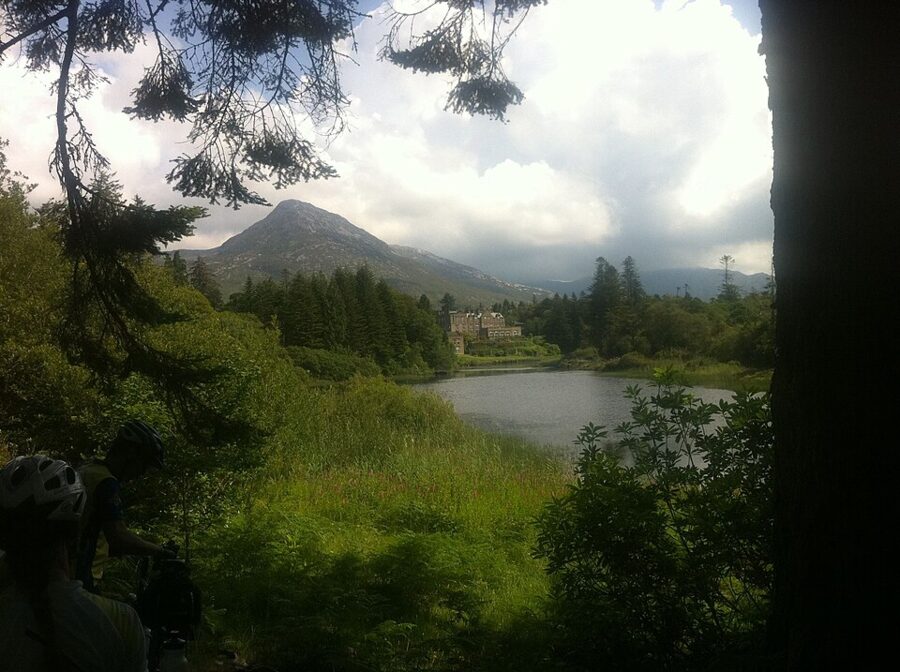
The estate map marks seven walks, about 16 km of path in all, through oak woods and along the river and the lake shore. The short ones are the Riverside Walk (1 km, about 30 minutes) and the Old Manor Walk (1 km); the Railway Walk and the Killeen Lake Walk are each 2 km, about 45 minutes. The Lakeside Walk is 3.5 km and takes an hour, the Lettery Loop is 1.4 km up to a viewpoint, and the Estate Greenway Loop is 5 km, about an hour and a quarter.
The estate is private, and the hotel publishes no rule for walkers who are not staying. The map itself says enquiries go to the reception desk, and that is what I would do: call in for a coffee or lunch, ask which paths are open that day, and stay off the river banks where people are fishing. Several houses on the map, the gate lodges among them, are private homes.
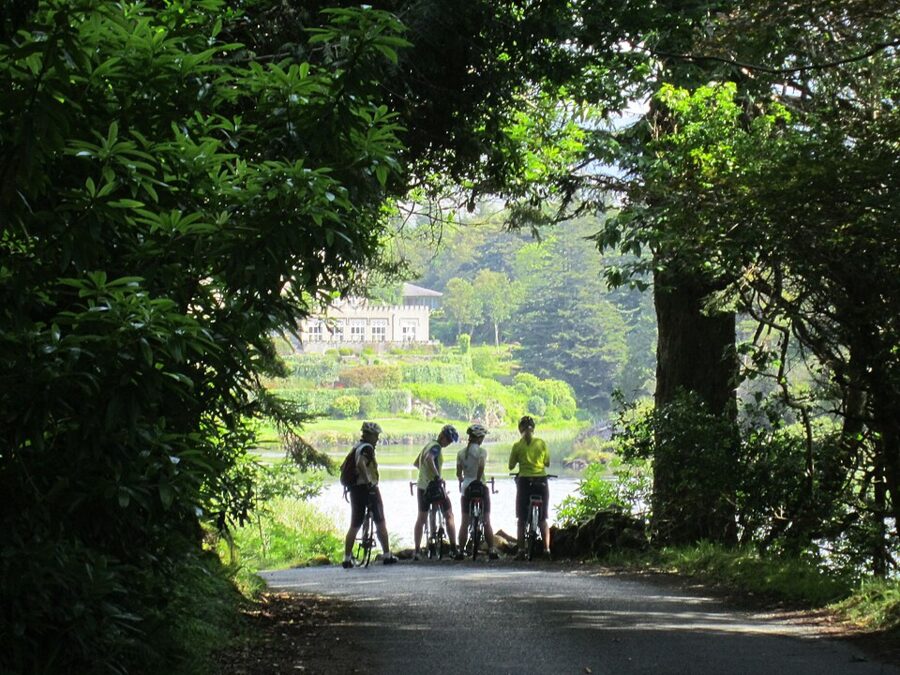

For the history, the hotel’s guided estate walk takes about two hours at an easy pace and costs €30 a person, €100 for a family of four, with children under twelve free. It runs through the estate’s past from the 1300s and points out the old oaks, and on a good day you may see red deer or a pine marten. The island tower is reached only by boat; from land, the Lakeside Walk gives the best view of it.
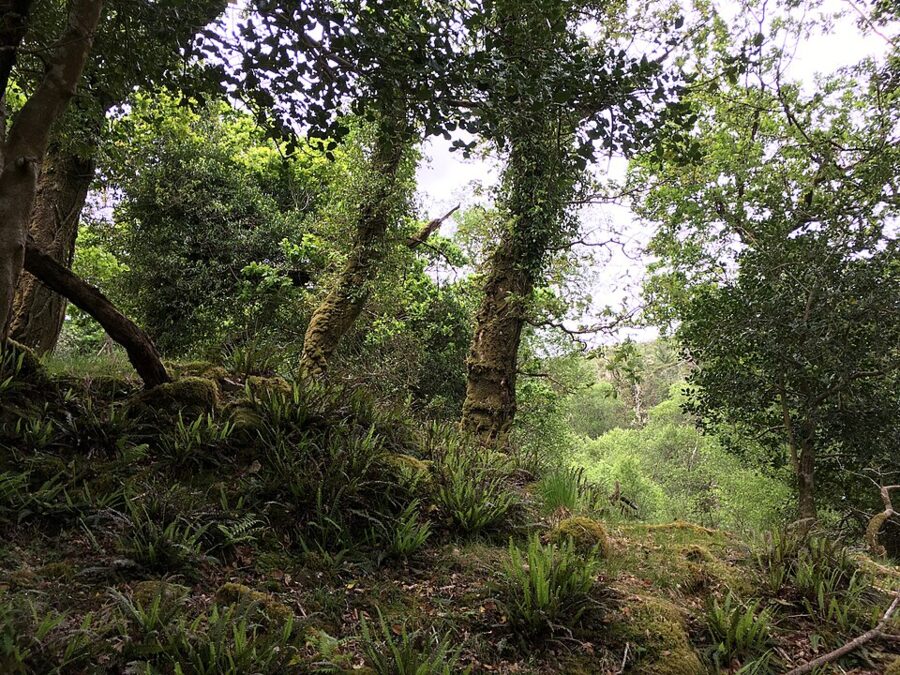
The inventory calls the estate an island of mature woodland in a bare country of bog and lakes, and that is exact. Peregrines, pine martens and red deer live here, and the hotel has been clearing invasive plants and replanting native trees.
The walled garden
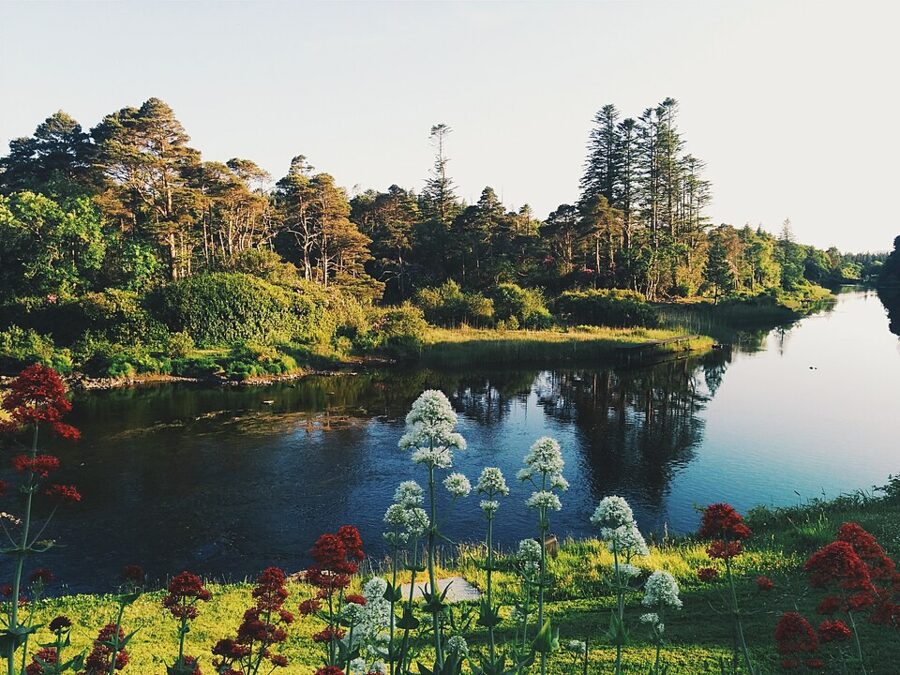
The walled garden beside the house has been restored over the last decade, its stone walls rebuilt in full by local masons. Cian Cunniffe has been head gardener since 2017, and the walled garden now grows espalier apples and pears, figs, mulberries, salads and vegetables for the kitchens, with a rose tunnel and herbaceous beds inside the walls. By the autumn of 2026 the garden team had counted 1,625 kg of produce for the year.
The estate map shows a garden café there, open in season. Late summer, with the beds full, is the time for it.
The fishery
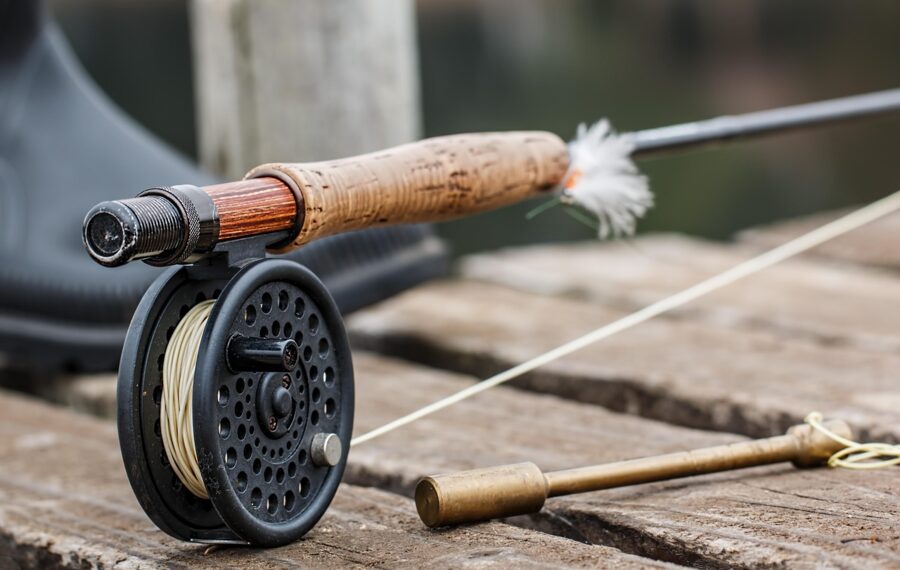
The Ballynahinch fishery is fly only, catch and release with barbless hooks, and open from 1 March to 30 September. No children under twelve fish the river. A few large spring salmon come in May, but it is a summer fishery: grilse, salmon back from a single winter at sea, arrive in early June and keep coming until the last day, and the sea trout are best from early June to mid-July.
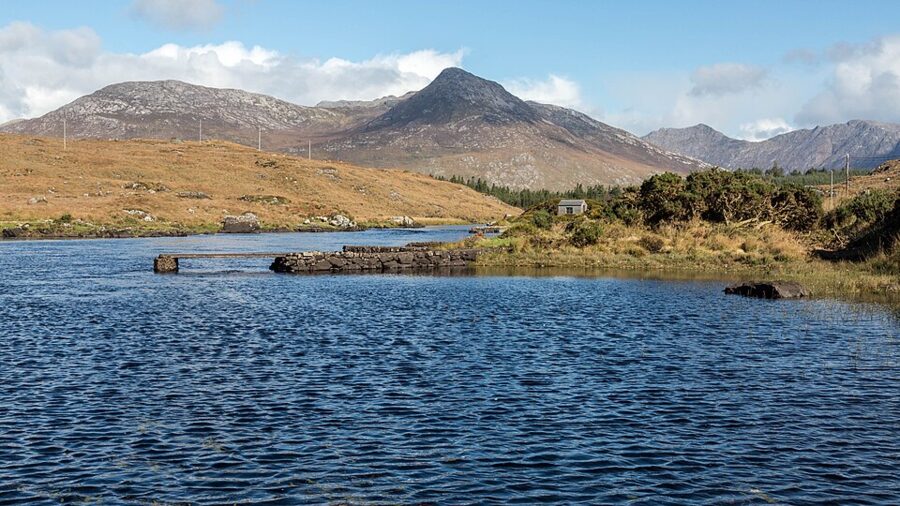

Beginners can book a tutorial with a guide; experienced anglers can fish a beat on their own, with the day licence, equipment and flies included, from €140 a person for a three-hour session. Inland on the estate, Lough Nabrucka is stocked with rainbow trout from mid-April to August for anyone who wants an easier morning.
The fishery credits the end of the Irish drift-net fishery at sea in 2007 with doubling its salmon run the following year.

The railway and the Greenway
The Midland Great Western Railway’s line from Galway to Clifden opened on 1 July 1895 and ran across the bog by Oughterard, Maam Cross and Recess. Ballynahinch had its own station at Cloonbeg, beside the road down to Roundstone, and the station house, the goods shed and the signal box all still stand, now private. The line closed on 29 April 1935; the hotel’s history says 1936, but the railway’s own dates are 1895 to 1935.
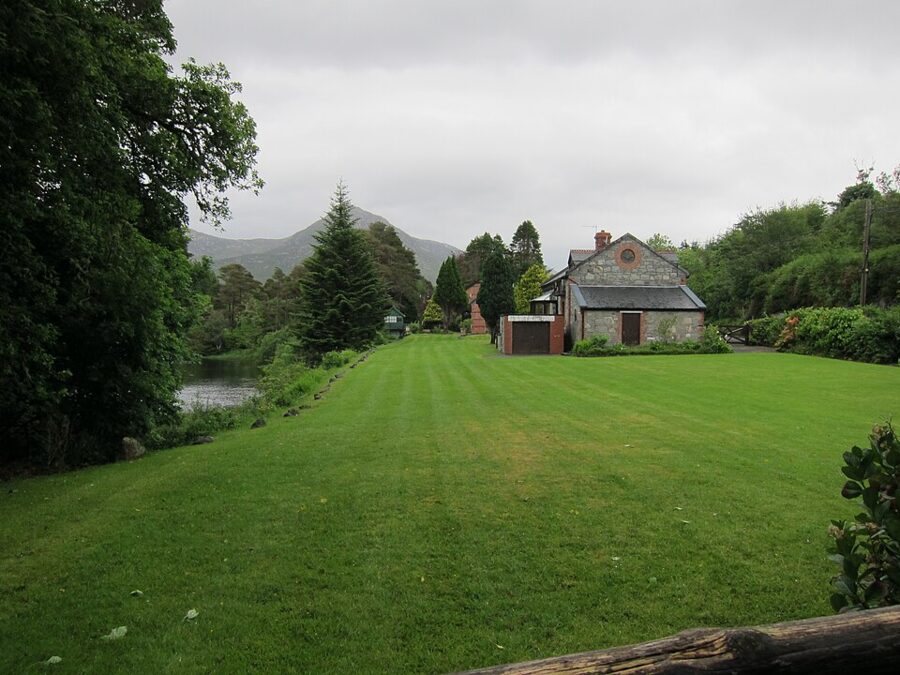

Recess had two stops: Recess station and a halt for the Recess Hotel, which the railway company owned. On 13 October 1922, during the Civil War, Republicans burned the hotel and Glendollagh House nearby so that the National Army could not use them as billets. A house stands on the Glendollagh site today.
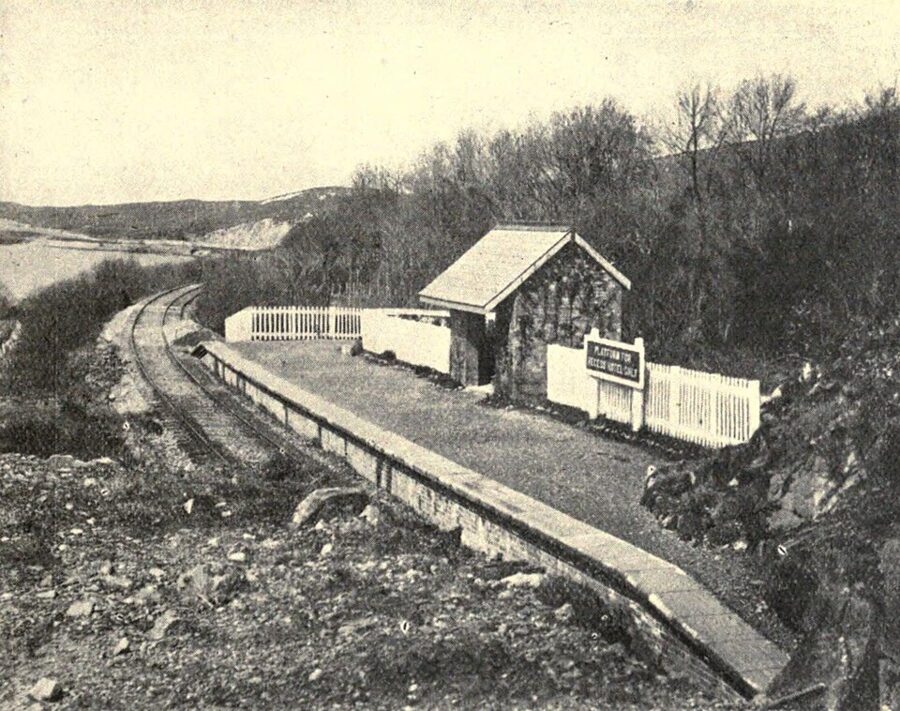
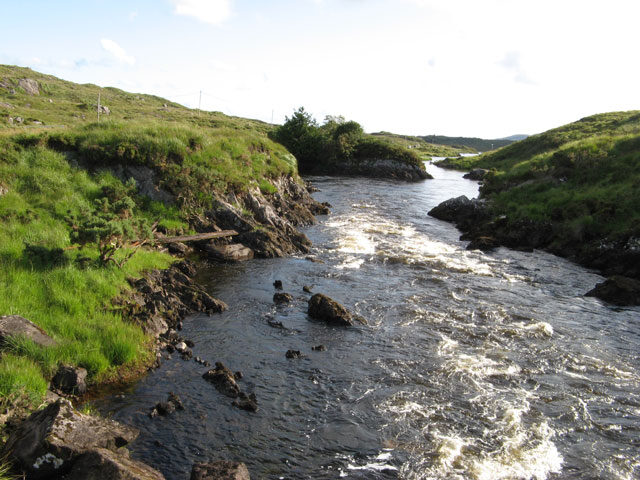
The old trackbed is coming back as the Connemara Greenway. A 6 km section from Athry to Cloonbeg, running along the edge of the estate, was opened in May 2018, as the Connacht Tribune reported that November. It is level and away from traffic, and the estate map shows Greenway car parks at both ends of the stretch, with the estate’s own Greenway loop joining it.
The rest of the route from Oughterard to Clifden is still a project. Oughterard, Recess and Clifden community groups are behind it with Galway County Council, whose 2025 environmental assessment of the Oughterard to Clifden route was part of the planning work that year. Until more opens, the Ballynahinch stretch is the best of it, and the hotel lends its bikes to guests for it.
Sraith Salach (Recess)
Sraith Salach is inside the Connemara Gaeltacht, where the Irish name is the official one; Recess is the English form most maps still show. Sraith Salach is usually explained as the river meadow of the willows (the willow is saileach, and the name is sometimes written Sraith Saileach). The Conamara Láir community describes it as a small bilingual village 57 km from Galway and 20.5 km from Clifden, among hills, woods and mountains. It is a crossroads more than a village: the N59 passes through, and the R344 turns off north up the Inagh Valley.
Sraith Salach sits on Glendollagh Lough at the foot of Lissoughter. Seán Lester, the last Secretary General of the League of Nations, lived here from his retirement until his death in 1959.
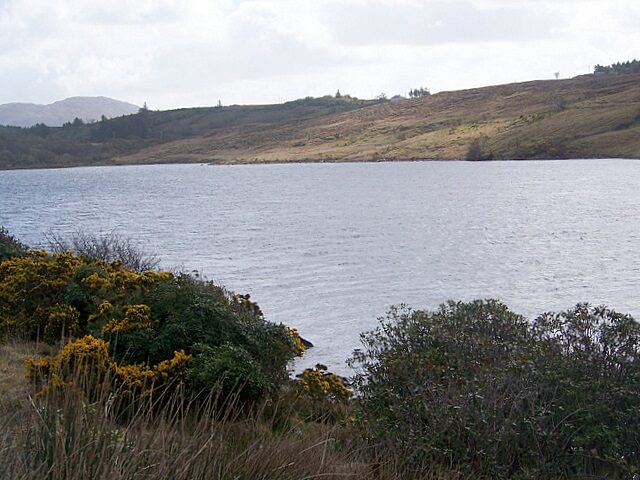

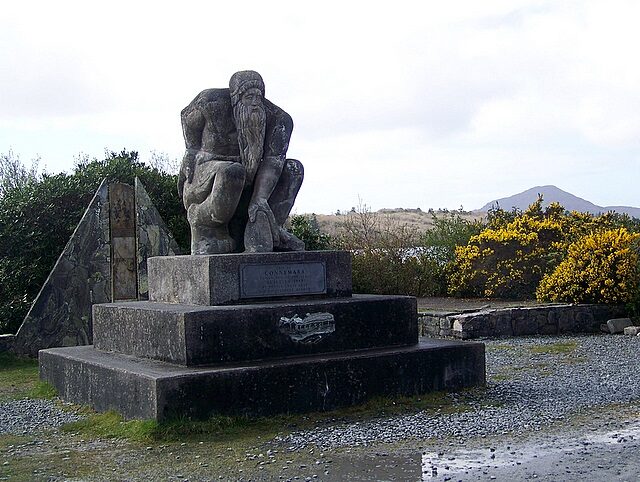
Joyce’s craft shop, by the lake on the N59, is a family business that says it opened in 1895 and has worked Connemara marble for four generations; it was posting new marble platters, finished at the stoneyard in Recess, in November 2026. Outside stands the Connemara Giant, a stone figure the shop put up in 1999 for no stated reason. The village’s own story is that touching his hand passes on the knowledge of his ancient tribe.

Lissoughter and the green marble
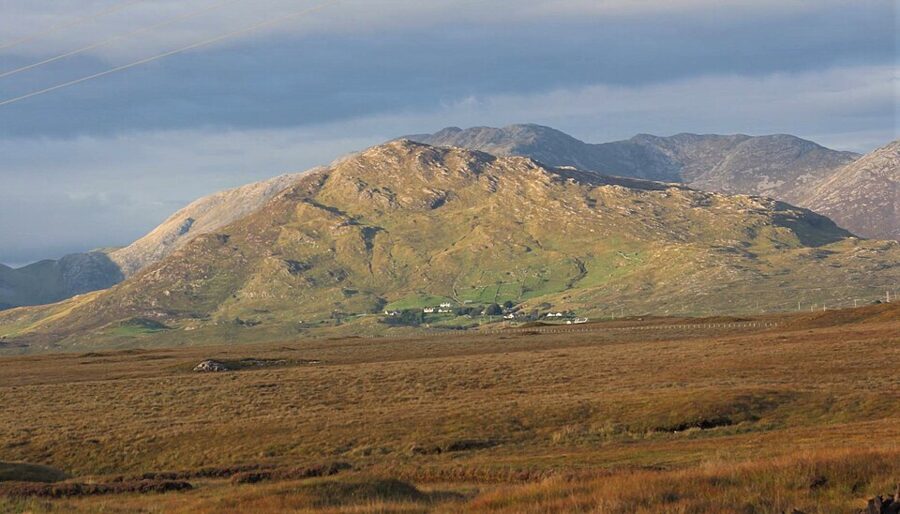
Lissoughter (Cnoc Lios Uachtair, the hill of the upper ring-fort) is a lone 401 m hill between the Bens and the Maumturks, just north of Recess. The quarry on its southern slopes is one of the classic sources of Connemara marble, the green stone quarried in Connemara since the 1700s and now called the national gemstone. It is also quarried near Clifden.
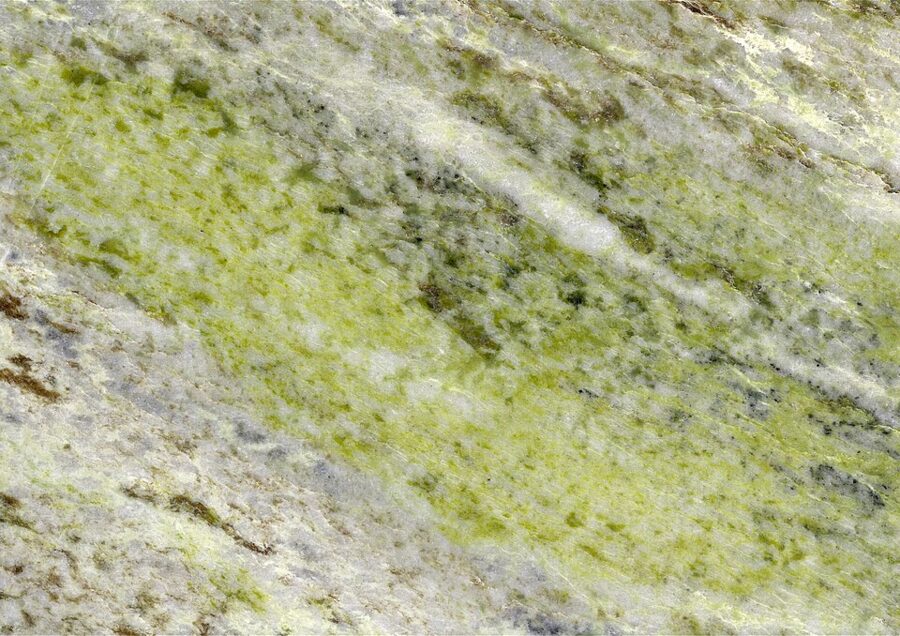
The stone began as a silica-rich dolomitic limestone laid down on a continental shelf, and about 460 million years ago the Grampian mountain-building cooked it into marble. Serpentine gives it the green, in bands and swirls through the white. It weathers badly outdoors, which is why you see it in fireplaces, altars and jewellery rather than in walls.


Derryclare, Lough Inagh and the valley road
West of Recess the N59 runs along Derryclare Lough (Loch Dhoire an Chláir), the link in the chain between Lough Inagh and Ballynahinch Lake. Pine Island, a knot of Scots pine on a rock in the lake with the Bens behind, is one of the most photographed views in Connemara, and there is a viewpoint lay-by on the road for it. Come early or late in the day, when the light is low and the water is often still.
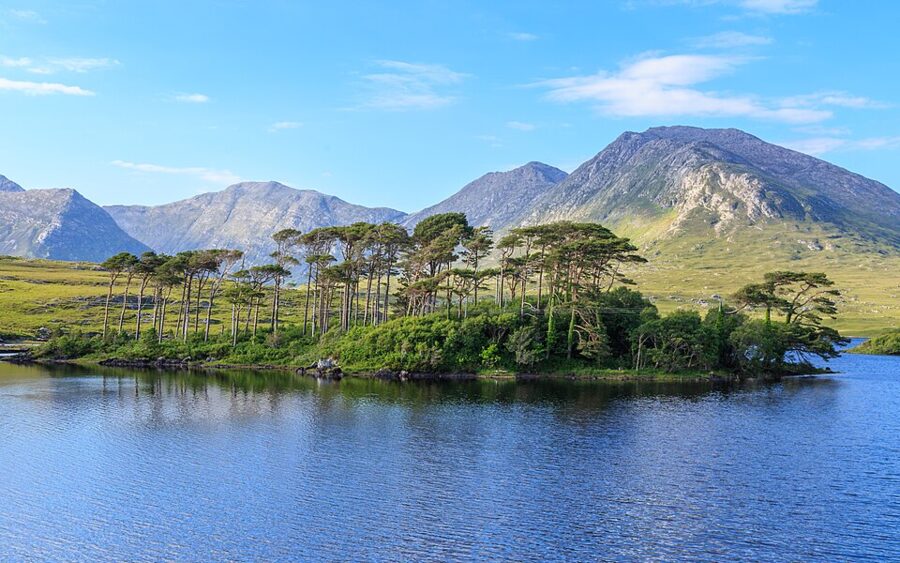

On the far shore, the 19-hectare Derryclare Nature Reserve protects a remnant of native oak and holly wood inside the larger Derryclare Wood, a Coillte conifer forest of about 789 hectares. Above it is the Glencoaghan Horseshoe, a 16 km round of six Bens that takes most people eight or nine hours. The northern Bens, across the valley, lie inside Connemara National Park.

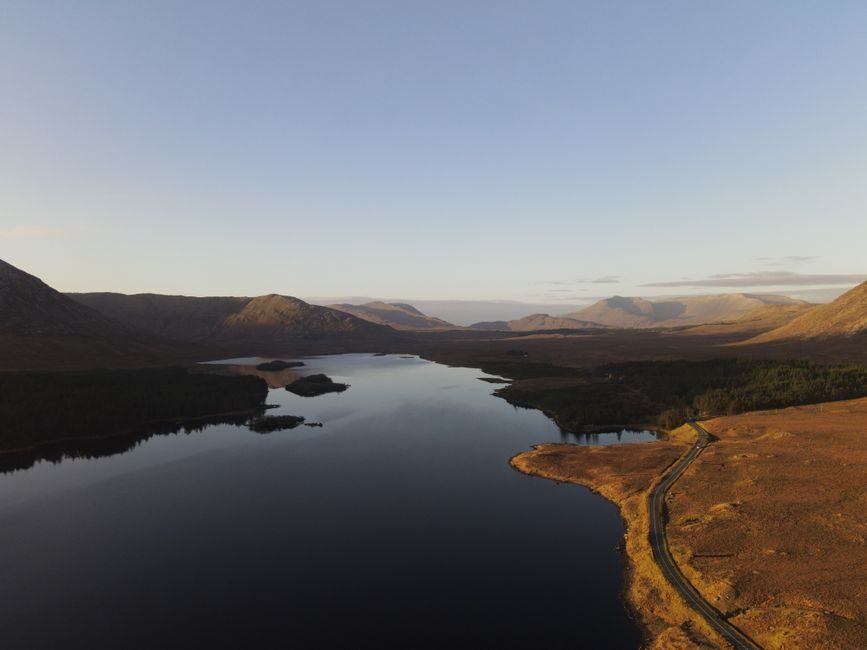
Lough Inagh (Loch Eidhneach) takes its name from the valley at its head, Gleann Eidhneach, the valley of ivy. The R344 runs up its eastern shore and on to the Kylemore Pass, with the Bens on the left and the Maumturks on the right, and it is the best mountain road in Connemara. Driving it north and on to Kylemore Abbey is the shortest way from Galway to the Abbey and the villages of Letterfrack and Kylemore.

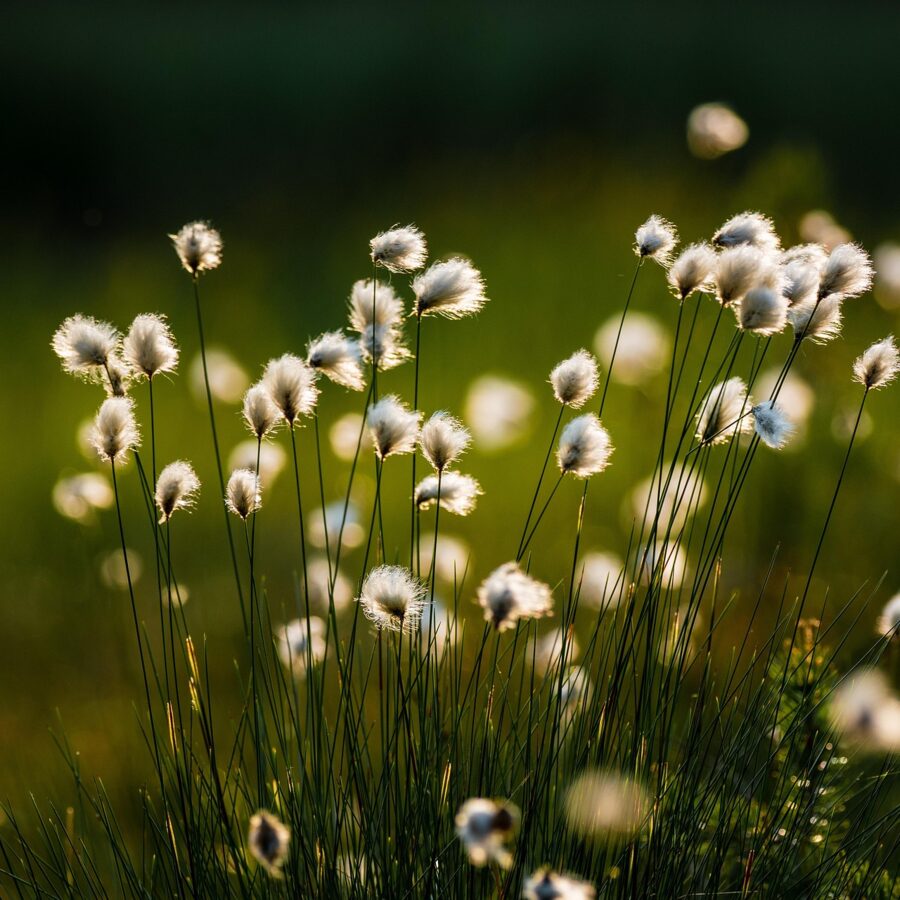
The lodge on the lake shore, Inagh Lodge, was one of the Berridges’ fishing lodges of the 1880s. In June the valley floor is white with bog cotton, and in October the deer grass on the slopes turns rust. I would drive it in the evening, north to south, with the light coming across the Bens.

Down the river to Toombeola
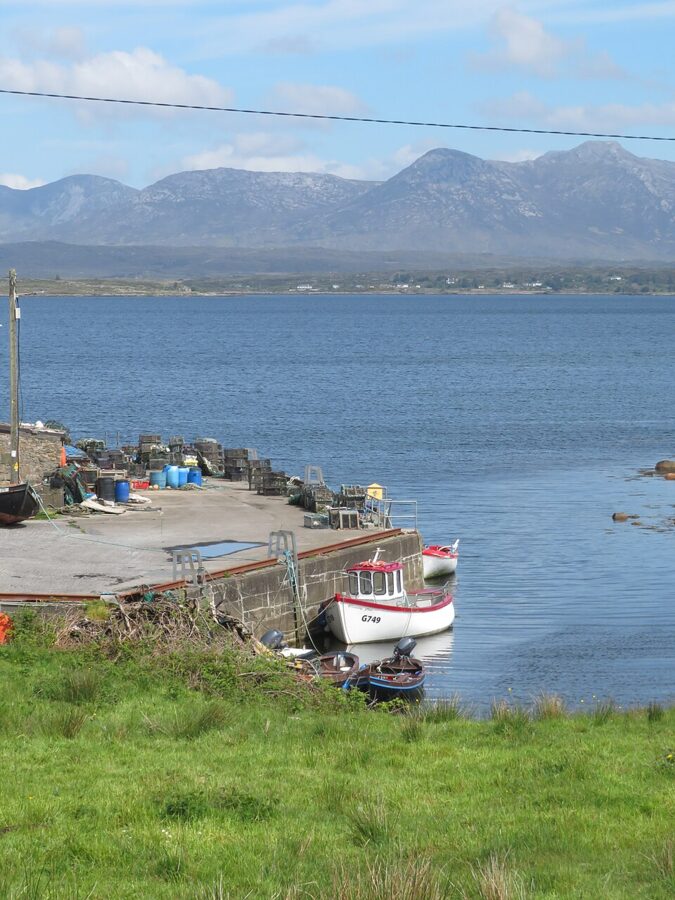
The R341 runs south from the castle gate beside the river to Toombeola (Tuaim Beola, usually explained as the tomb of Beola, an ancient chief of the area). The Owenmore enters the sea under Toombeola Bridge, built between 1828 and 1831 as part of Alexander Nimmo’s roads through Connemara. Locals still call the spot the Fishery.
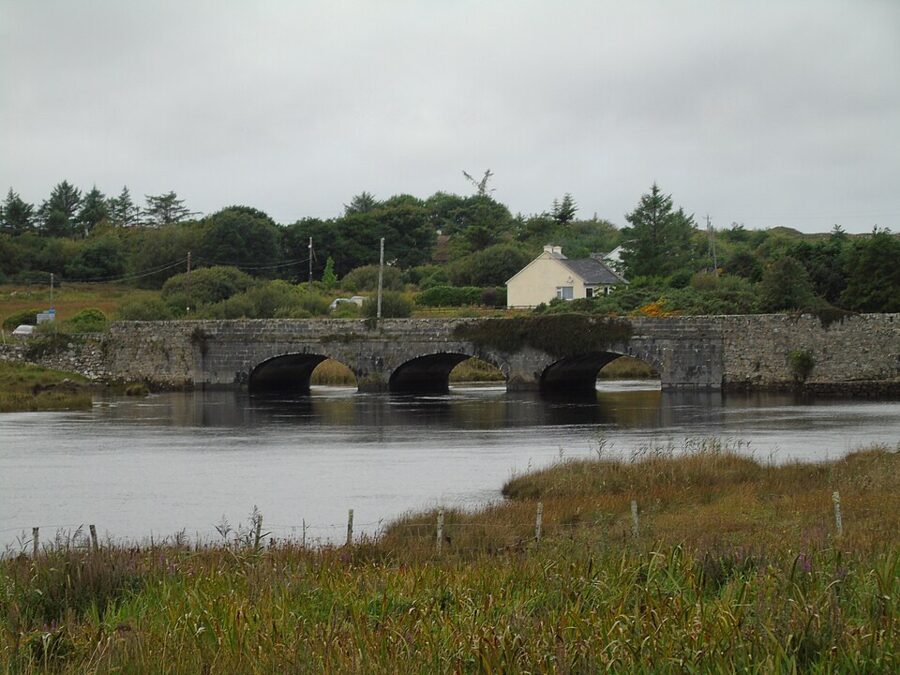

Nearby are the ruins of St Patrick’s, a Dominican abbey founded in 1427 with O’Flaherty help and abandoned after Crown soldiers attacked it in 1558–59; its graveyard is still in use. Local tradition says one of the last friars, a Father John Tully, swam the river to escape and was shot on the far bank. From Toombeola the road carries on down Bertraghboy Bay, and the Bog Road cuts west across the bog to Ballinaboy; and Roundstone is ten minutes away.


Getting there, and when to go
From Galway, take the N59 west through Moycullen, Oughterard and Maam Cross to Recess, then turn left onto the R341, signposted for Roundstone and Ballynahinch; the castle gate is about 5 km down it on the right. That is about 62 km and an hour without stops. From Clifden, take the N59 east along the north shore of the lake and the same turn; it is about a quarter of an hour.
There is no bus to the gate. Citylink route 923 and Bus Éireann route 419 run from Galway to Clifden along the N59 through Recess, and the hotel’s travel page suggests the bus to Clifden and a taxi back. Walkers and cyclists on the Greenway can use its car parks; the hotel car park is for guests and diners.
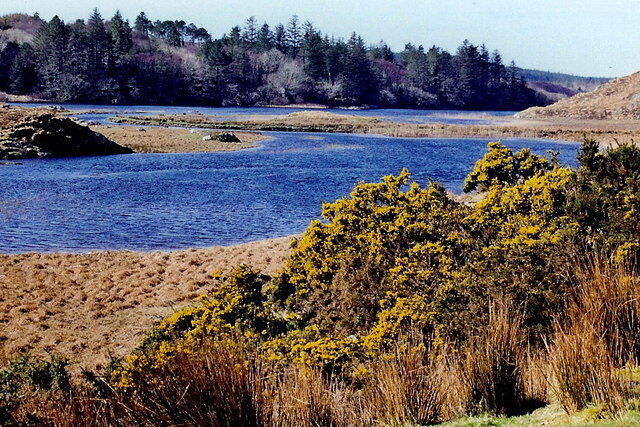

For anglers the months pick themselves: June and early July, for grilse and sea trout. For walkers I would come in May, before the midges and with the oak leaves new, or in late September and October, when the fishing has stopped, the woods are quiet and the bog has turned colour. Winter works too if you only want the woods and a fire, but the sun sets at about 16:20 in December.
Ballynahinch combines easily with Roundstone, ten minutes south, or Clifden, a quarter of an hour west. A morning on the estate walks, lunch in the pub and the drive down to Toombeola and Roundstone makes a full, unhurried day.
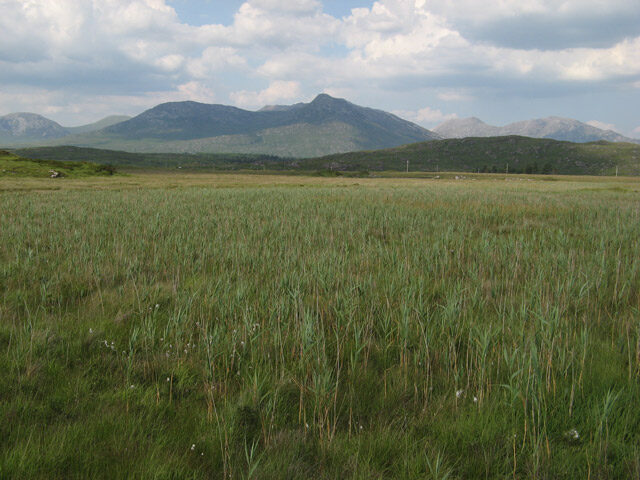

Before you leave, ask at the desk and walk the Lakeside path far enough to see the island. The tower is small from the shore, a grey stub in the trees, and it has outlasted the O’Flahertys, the Martins, the insurance men and the prince. Baile na hInse, the settlement of the island: the hotel took the name, but the island had it first.